

If you've spent any time in the AI music world, you've heard of Suno. It's the app that made AI songwriting feel like magic — type a few words, wait a minute, and get a surprisingly decent track with vocals and everything. Over 20 million people have tried it, and it's still the first name most people think of when someone says "AI music."
But if you've used Suno for more than a week or two, you've probably also felt the frustration. The credits that vanish before you get anything usable. The songs that sound incredible on one try and completely fall apart on the next. The nagging question of whether you actually own what you make.
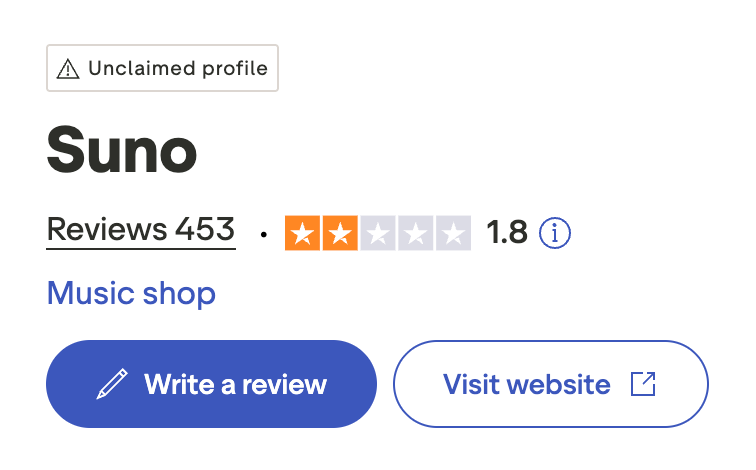
You're not alone. Suno currently sits at a 1.8 out of 5 on Trustpilot across 450+ reviews — and those reviews paint a pretty consistent picture.
The good news? The AI music space has exploded. The market is projected to hit $2.8 billion by 2030 (Grand View Research), and there are now real alternatives worth your time — each with different strengths depending on what you actually need. This guide is here to help you figure out which one fits.
So what's actually wrong with Suno?
Let's be specific, because the frustrations aren't random — they point to real design decisions that affect your workflow.
You burn through credits just trying to get something usable
Suno charges 10 credits per generation no matter what comes out. And it always generates two songs at once, so you're really spending 10 credits for a pair whether you wanted both or not. There's no rollover if you don't use your monthly credits.
In practice, this means a lot of your budget goes to throwaway generations. Community discussions on Reddit are full of people reporting they burned their entire monthly Pro allocation ($10/month, 2,500 credits) in a couple of days trying to nail one track. When the majority of your outputs need to be regenerated, the math stops working fast.
v5 made things worse, not better
This one really stings. Users who upgraded expecting better quality found that Suno's v5 model introduced new problems: persistent audio artifacts, words that get consistently mispronounced, random lyrics the AI decides to insert on its own, and mid-track voice switching where a male vocal suddenly flips female (or vice versa). Extended tracks tend to wander away from your original prompt.
Worse, the community has noticed what they call "silent platform drift" — the models change behavior without any announcement, so a prompt that worked perfectly yesterday might produce something completely different today.
You can't really edit anything
This is the big one for anyone with production experience. Suno gives you a finished audio file and that's it. No individual instrument control. No reliable BPM or key locking. No way to say "I love the verse but the chorus needs work." You either accept the whole thing or start over from scratch.
The recently launched Suno Studio beta tries to address this with a multitrack editor, but early feedback describes it as unpredictable.
The copyright situation is genuinely messy
The major labels came after Suno hard — Sony Music and Universal Music Group each filed separate copyright infringement lawsuits in June 2024. Warner Music Group settled in November 2025 — as part of the deal, Suno committed to building entirely new models trained on licensed data in 2026, which means the current models will eventually be deprecated. But the Sony lawsuit? Still active.
And here's the part that makes commercial creators nervous: Suno's own documentation says users "generally are not considered the owner" of generated songs. If you're putting AI music in a YouTube video, a podcast, or a client project, that ambiguity matters.
Getting help is nearly impossible
According to Trustpilot reviews, users report wait times of weeks or longer for support tickets. Multiple users describe being locked out of paid accounts for months with zero resolution. Unauthorized charges after cancellation keep showing up in reviews. It's a frustrating experience when things go wrong.
The alternatives worth knowing about
Here's what else is out there — with honest assessments of what each platform actually delivers and where it falls short.
Udio — the best-sounding vocals you can't download
If pure audio quality is your north star, Udio is remarkable. It produces the most human-sounding AI vocals available right now, with 48kHz stereo output and arrangements that genuinely approach professional studio polish. Its Magic Edit feature lets you regenerate specific sections while keeping the rest intact, which is the kind of creative control Suno doesn't offer. Add in audio-to-audio remixing, key control, and seed values for reproducibility, and you've got a seriously capable tool.
Pricing: Free tier gives you 10 daily credits (~3 songs/day, non-commercial). Standard is $10/month for 2,400 credits. Pro costs $30/month for 6,000 credits.
The catch (and it's a big one): After Udio's October 2025 licensing deal with Universal Music Group, they've suspended WAV, video, and stem downloads for most users. You can generate incredible-sounding music... but you can't take it anywhere. The platform is transitioning to a new licensed model, but the timeline is unclear. Until downloads come back, Udio is essentially a listening experience, not a production tool.
Best for: Producers who want the highest vocal quality and can wait for the download situation to resolve.
AIVA — the composer's choice, if you don't need vocals
If you work in a DAW and you've been frustrated that AI music always arrives as a locked audio file, AIVA is worth a serious look. It's the only major platform offering full MIDI export with an integrated editor — meaning you can take what the AI generates and tweak every single note in Logic, Ableton, FL Studio, or whatever you use.
Over 250 style presets cover everything from classical to electronic, and you can upload your own MIDI or audio to influence the AI's composition style. Fun fact: AIVA was the first AI officially registered as a composer with SACEM, France's music rights society.
Pricing: Free gives 3 downloads/month (non-commercial, and AIVA owns the copyright). Standard at €11/month (annual) or €15/month gets you 15 downloads with social media monetization — but read the fine print, because AIVA still retains copyright. You need the Pro plan at €33/month (annual) for full copyright ownership and 300 downloads/month.
Limitations: No vocal generation whatsoever. And that copyright retention on the Standard tier catches people off guard — make sure you know what you're signing up for.
Best for: Film and game composers who need orchestral scoring, and producers who want AI-generated MIDI as a starting point they can refine themselves.
Stable Audio — rock-solid instrumentals for developers
Stability AI's entry into AI music is quiet but capable. It's trained exclusively on licensed music from AudioSparx, so the copyright foundation is clean. Version 2.5 brought audio inpainting, better musical structure, and impressively fast inference — under 2 seconds on GPU for tracks up to 3 minutes.
What makes Stable Audio interesting is the developer story. They also offer open-source models (Stable Audio Open) under a community license that's free for individuals and organizations under $1M annual revenue. If you want to build AI music into your own product, that's significant.
Pricing: Free tier allows 10 tracks/month (3 minutes max, non-commercial). Pro costs $11.99/month. Studio runs $29.99/month. Max plan is $89.99/month with priority generation. Enterprise offers custom pricing with model fine-tuning and self-hosting.
Limitations: No vocals at all. Three-minute maximum. The free tier is pretty much a demo.
Best for: Game developers, sound designers, and technical teams who want API access or the ability to self-host their own models.
ElevenLabs Music — the new kid with the cleanest legal story
Launched in August 2025, Eleven Music comes from ElevenLabs, the company that's been leading the voice synthesis space. They've applied that expertise to full song generation with vocals, and the results are impressive — 44.1kHz output quality with multilingual support across English, Spanish, French, German, Japanese, and more.
The big differentiator here is licensing. ElevenLabs trained on licensed data from Merlin Network and Kobalt Music Group from day one. No lawsuits, no retroactive licensing deals, no ambiguity. If you're creating for commercial use and sleep quality matters to you, that's a real advantage.
Pricing: About $0.50 per minute of generated audio, integrated into ElevenLabs' credit system. Free tier gives you ~20 minutes (non-commercial). Starter at $5/month unlocks commercial licensing. Pro runs $99/month for heavier usage.
Limitations: That per-minute billing adds up quickly if you like to iterate. And the platform is only about six months old — it's good, but it doesn't yet have the feature depth of more established tools.
Best for: Creators who need commercial-safe outputs from day one, and developers who want to integrate music generation via API.
Beatoven.ai — ethically trained, budget-friendly, built for video
If you make YouTube videos, podcasts, or any kind of visual content and you just need worry-free background music that matches the mood, Beatoven.ai deserves your attention. It's the first AI music company certified by Fairly Trained, meaning its models were built exclusively on licensed music with artist compensation.
Its Maestro model offers mood-based composition across 16 emotions, which is exactly what you want when you're scoring a documentary scene or matching energy in a vlog.
Pricing: Creator plan is $10/month for 30 minutes of downloads. Visionary runs $20/month for 60 minutes. Pay-as-you-go at $3/minute with no expiration. Annual billing saves up to 50%.
Limitations: No vocals. Only 8 genres. Can't distribute on Spotify or Apple Music. And Beatoven retains ownership of generated tracks — you get usage rights, not ownership.
Best for: Video creators on a budget who want legally clean instrumental music without any copyright headaches.
Soundraw — the best way to customize without prompting
Soundraw takes a completely different approach. Instead of typing descriptions, you pick genre, mood, theme, tempo, and length, then customize at the bar level with a mixer that lets you toggle, mute, and solo individual elements — melody, backing, bass, drums, and fill. It's almost like an automated composition tool rather than a generative one.
Everything is trained on in-house produced music, so licensing is crystal clear.
Pricing: Creator plans start at ~$11/month with unlimited generation. Artist Unlimited at $32.49/month gives you WAV, stems, and perpetual licensing — meaning tracks stay licensed even if you cancel.
Limitations: No vocals. MP3-only on basic plans. If you're a producer used to working in a DAW, it might feel limiting.
Best for: Content creators who want reliable, customizable instrumental tracks and prefer clicking over prompting. The bar-level mixer is genuinely the best non-DAW editing interface in the space.
Boomy — the easiest path from creation to Spotify
Boomy's pitch is simple: generate a song with one click and distribute it to 40+ streaming platforms — Spotify, Apple Music, YouTube, TikTok — directly from the app. It's the only major platform offering a complete create-to-distribute pipeline. The 80% net streaming revenue share is competitive.
Pricing: Free lets you create unlimited songs but only save 25 and release 1. Creator at $9.99/month unlocks 500 saves and 10 downloads. Pro at $29.99/month adds unlimited saves and 250 downloads.
Limitations: Let's be real — the audio quality isn't in the same league as Udio or even Suno. The interface is reportedly laggy. And in 2023, Spotify removed thousands of Boomy tracks over artificial stream manipulation allegations, which isn't a great look.
Best for: Hobbyists and first-timers curious about getting AI music onto streaming platforms. Not for professional use.
Mubert — the developer's choice
If you need to generate music programmatically — inside an app, a game, or an Adobe workflow — Mubert has the most mature API in the space. It also integrates directly with After Effects and Premiere Pro. Built on 1M+ samples from 4,000+ musicians who earn compensation.
Pricing: Free gives 25 tracks/month (attribution required). Creator at $14/month removes attribution. Business at $199/month enables sublicensing and in-app use.
Best for: Developers integrating music into products, and enterprise teams that need API-driven generation at scale.
Pricing at a glance
| Platform | Free tier | Entry paid | Pro plan | Vocals | MIDI export |
|---|---|---|---|---|---|
| Suno | 50 credits/day | $10/mo | $30/mo | ✅ | ❌ |
| Udio | 10 credits/day | $10/mo | $30/mo | ✅ | ❌ |
| AIVA | 3 downloads/mo | €11/mo | €33/mo | ❌ | ✅ |
| Stable Audio | 10 tracks/mo | $11.99/mo | $89.99/mo | ❌ | ❌ |
| ElevenLabs Music | ~20 min | $5/mo | $99/mo | ✅ | ❌ |
| Beatoven.ai | Free trial | $10/mo | $20/mo | ❌ | ❌ |
| Soundraw | Unlimited gen | ~$11/mo | $32.49/mo | ❌ | ❌ |
| Boomy | Unlimited (25 saves) | $9.99/mo | $29.99/mo | ✅ | ❌ |
| Mubert | 25 tracks/mo | $14/mo | $199/mo | ❌ | ❌ |
What's still missing from all of them
After trying all these platforms, a few gaps keep standing out — and they're worth thinking about whether you're choosing a tool today or betting on where things are going.
Nobody combines everything in one place
Here's the frustrating reality: each of these tools does one or two things well, but none of them does it all. Udio nails vocals. AIVA nails orchestral composition and MIDI export. Stable Audio nails instrumentals. Beatoven nails ethical background music. But if you want to generate a song, separate the stems, swap the vocal, export to MIDI, and master the final mix — you're switching between 3 to 5 different apps. That's where the most time gets wasted.
MIDI is still a luxury feature
If you're a producer who works in a DAW, this is probably the gap that hurts the most. Almost every AI music tool gives you a finished audio file and nothing else. AIVA is the only major exception with real MIDI export. For everyone else, AI-generated music is a take-it-or-leave-it proposition — you can't go in and fix the chord voicing or swap the bass instrument or rearrange the bridge. That's a huge barrier for serious musicians who want AI to speed up their process, not replace it.
The prompt-and-pray model is hitting its limits
Type a prompt. Wait. Hope the output is good. If it isn't, tweak the prompt slightly and try again. This is how most AI music tools work, and honestly, it starts to feel pretty random after a while. Research on multi-agent composition frameworks shows that AI systems working through multiple collaborative steps produce measurably better results than single-prompt generation. There's growing interest in what people are calling "agentic" music creation — AI that maintains context across a session, remembers what you're working on, and can handle multi-step instructions like "take the verse melody, transpose it up a fifth, and layer it with strings." It's early, but the direction is clear.
Multilingual quality still isn't there
Suno, Udio, and ElevenLabs all claim multilingual support, but the honest reality is that English gets the best results by a wide margin. If you're creating music for a Hindi-speaking, Korean-speaking, or Portuguese-speaking audience, you'll notice the quality drop. As AI music goes global, this gap becomes a bigger deal.
Pure AI music creates volume, not value
This one's worth reflecting on. Deezer reported that AI-generated tracks now make up about 34% of all daily uploads to the platform — but account for only 0.5% of total streams. And up to 85% of those streams were flagged as fraudulent. The lesson? Flooding streaming platforms with AI-generated songs isn't creating real engagement. The real value lies in human creativity augmented by AI — using these tools to generate starting points, then editing, remixing, and finishing with your own creative judgment. The "generate and hope" era is fading. The "generate, edit, and own" era is just beginning.
Where things are heading
Three trends to watch:
Licensing is becoming table stakes. Warner settled with Suno. Universal settled with Udio. Both platforms are building new models on licensed data, and the old unlicensed models will be deprecated. ElevenLabs and Beatoven built on licensed foundations from the start. If you're using AI music for anything commercial, choose platforms where the licensing story is clear — the legal risk of using outputs from questionable training data is real.
Prompting will give way to conversation. The best AI tools in other domains — coding assistants, design tools, writing aids — have moved from single prompts to ongoing conversations where the AI maintains context. Music will follow. Expect to see tools where you can say "I like the intro but make the drop hit harder" and have the AI understand what you mean, rather than starting from scratch every time.
Someone will build the all-in-one. Right now, no single platform delivers the full loop: generate, separate, transform, export MIDI, mix, master, distribute. The first tool that does this well — that lets you stay in one workspace from idea to finished track — will probably define the next chapter of AI music creation.
The bottom line
The AI music landscape in 2026 is more capable than ever, but also more fragmented. Suno is still the default, but its credit economics, quality inconsistency, and copyright uncertainty leave a lot of room for alternatives. Which one is right for you depends on what you're making:
- Highest vocal quality: Udio (once downloads resume)
- Orchestral composition + MIDI export: AIVA
- Cleanest legal foundation: ElevenLabs Music
- Budget-friendly video scoring: Beatoven.ai
- Bar-level control without prompting: Soundraw
- Enterprise/developer API: Stable Audio or Mubert
- Streaming distribution: Boomy (for hobbyists)
The bigger picture? Creators don't just want AI to generate music — they want AI to participate in their creative process. Generate, then edit. Create, then refine. The tools that figure this out will win.
One more thing
We built Gliss because we kept running into these exact gaps ourselves. It's an AI music agent that combines song generation, vocal transformation, audio-to-MIDI transcription, MIDI editing, stem separation, mastering, and cover art — all in one conversational workspace. Instead of switching between five different apps, you describe what you want and the agent handles the rest.
If any of the frustrations in this article sounded familiar, give it a try. It's free to start.
पढ़ने के लिए धन्यवाद!
अधिक पोस्ट पढ़ें